

Extreme heat and outdoor working
Rising daytime temperatures are taking their toll on those who work outdoors. And things are likely to get worse.


It’s never fun working in a heatwave. Extreme heat makes the working day more challenging for everyone. But all the more so for those working outdoors.
I’m not talking, though, about the quick dash from the tube station to the office. Or about driving from one air-conditioned venue to another. Or about a leisurely lunchtime stroll to the sandwich place around the corner.
I’m talking about people who are actually working outdoors. I’m talking about scaffolders, construction workers, farmers, countryside rangers, electricity pylon repair people. About people who are not just working outdoors, but doing hard physical work.
Jobs like these are hard enough at the best of times. But as the mercury rises, they become even more challenging.
They can even, in fact, be fatal.
Extreme heat is more than just an inconvenience
The International Labour Organisation estimates that, every year, around 19,000 workers die as a result of excessive heat at work. A further 23 million suffer heat-related occupational injuries. And over 2 million disability-adjusted life years are lost. (Note: These figures are for all workers, whether they work indoors or outdoors.)
Excessive temperatures can cause heat exhaustion and heat stroke, the latter of which can result in unconsciousness and death. They can also place increased stress on the heart and kidneys, with the potential for long-term damage.
Furthermore, the sunshine that accompanies hot weather can cause sunburn, which in the long term can lead to skin cancer and other types of skin damage.
Working outdoors in high temperatures can also cause fatigue, which leads to poor decision making and a greater likelihood of workplace accidents. And workers can sustain injuries from tools and equipment that have become scorching hot to the touch, such as scaffolding and metal surfaces.
Extreme heat also has an impact on worker productivity. The World Health Organisation estimates, for example, that outdoor workers experience a 2-3% loss of productivity for every degree that temperatures rise above 20 degrees Celsius.
So if you’re working in a 30 degree heat, you’re essentially only working at 75% of full capacity. Or, to put it another way, it’s taking you all day to do what you’d otherwise get done by mid-afternoon.
And its impact is not felt equitably
In addition, extreme heat is a massive source of inequality. Outdoor workers around the world are often among the lower-paid members of the workforce. They are also more likely to be migrant workers, subject to visa and other restrictions (or even working illegally), or to have precarious employment arrangements.
This means that they are likely have fewer options when it comes to how, when and where they work. Consequently, they may feel compelled to work in extreme heat conditions, for fear of losing their pay, their job or their very ability to work and to support themselves and their families.
Those working outdoors are also less likely to benefit from workplace protections, which – when they exist at all – commonly apply only to indoor working environments.
Furthermore, those workers most at risk of extreme heat conditions are those working in parts of the world, typically around the equator, that have done least to cause climate change and its impacts.
Consequently, heat stress is becoming one of the most dangerous and most unequal impacts of climate change.
Definitions vary, but impacts do not
What do we mean, then, by extreme heat?
Extreme heat, especially when we’re talking about its impact on human beings, is usually measured as a function of temperature and humidity. This is because it’s easier for the body to cool down when the air’s less humid, and more difficult when humidity is high.
The specific temperature that constitutes ‘extreme’ heat, at least in public perception, also depends on where you are, what’s normal in that part of the world and how well equipped you are to deal with it.
A day when the temperature tops 30 degrees Celsius will be notable in Denmark, for example, but pretty much par for the course in Dubai. Although it is, of course, still infernally hot. And it still presents significant risks to those who are outside working in it.
The notion of extreme heat also depends on how long the increased temperatures last. A few hours of scorching temperatures are challenging, to be sure, but not insurmountable. But if the heat goes on for days or weeks without respite, even in the night-time hours, then its impact is significantly more substantial.
Here in the UK, for example, the Met Office suggests that extreme heat is anything above 25 degrees Celsius in the north of the country and anything above 28 degrees in the south. Provided such temperatures last for three or more consecutive days.
Other countries take differing views as to what constitutes extreme heat. But there’s a general consensus that anything from 30 degrees Celsius upwards is going to cause problems for anyone who’s outside in it. Especially if they’re doing physical work.
It’s also worth noting that, in temperatures above 30 degrees Celsius or so, the infrastructure that holds the economy and society together comes under increasing strain. Schools close, railways buckle and power transmission networks operate less efficiently.
All of which make it even harder for outdoor workers to do their jobs. Or even simply to get to work in the first place.
And we’re seeing more – and more severe – extreme heat days
We’re already seeing significantly more days with extreme heat than we did in the past. The International Institute for Environment and Development has calculated that major cities around the world are experiencing a quarter more hot days (by which they mean days with temperatures greater than 35 degrees Celsius) than they did thirty years ago.
Furthermore, the actual temperatures being experienced around the world rising, too. In the recent heatwave in the UK and across Europe, for example, new temperature records were established in many countries. And in the Middle East, temperatures of 45 to 50 degrees Celsius are no longer the anomaly that they once were.
Essentially, more places are having warm days. And warm places are having warmer days.
Compare the two maps below, which I’ve generated using Probable Futures excellent climate mapping tool.
The first shows the number of days in an average year with temperatures in excess of 32 degrees Celsius (90 degrees Fahrenheit), based on limited global warming above pre-industrial levels.
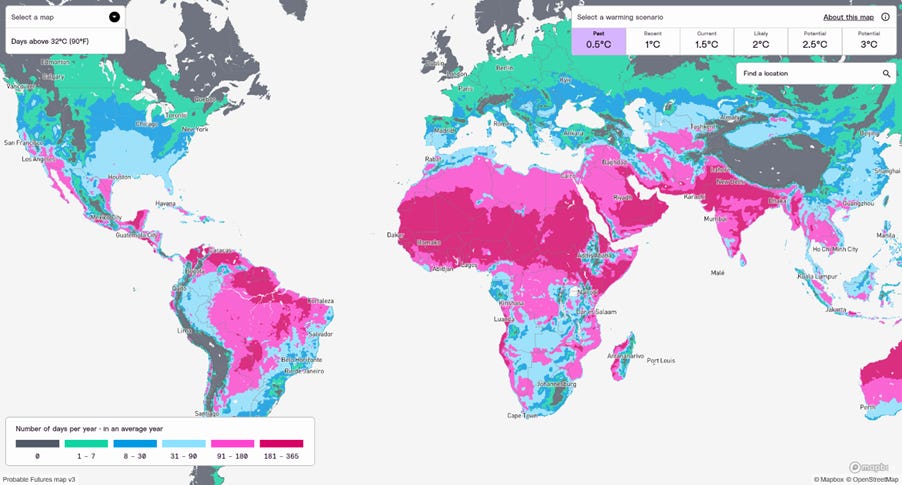
You can see that the Sahel region of Africa, northern parts of South America, the Middle East, much of Pakistan and India, and northern Australia all see a lot of extreme heat days. But Northern America, Europe, China and Russia are all fairly cool (meteorologically speaking).
The second map shows what things look like with 1.5 degrees Celsius of warming, which is essentially where we’re at right now.
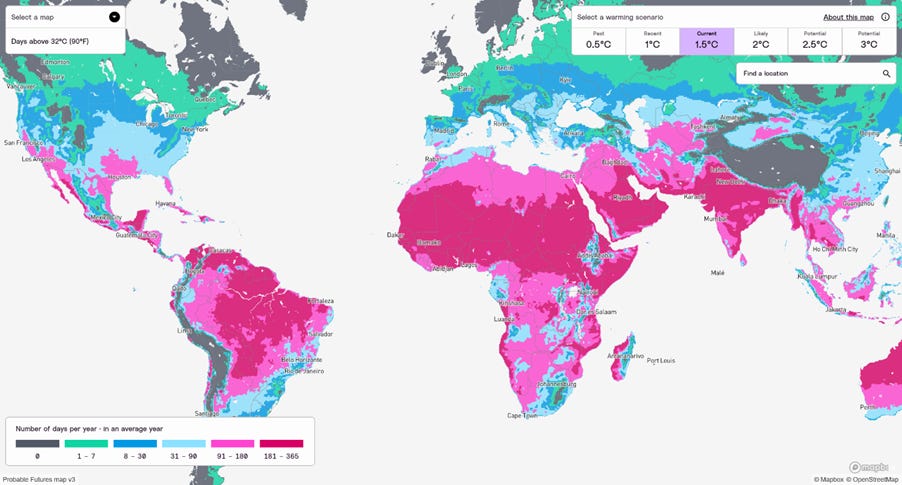
The broad picture is fairly similar, except that the pink and red zones have spread north and south, to encompass much more of South America, more of the southern United States, pretty much all of Africa, and much more of South East Asia.
Furthermore, much more of Europe and the United States are shaded green or blue, meaning that they’re also experiencing a greater number of extreme heat days. Sometimes for the first time, with the result that they’re struggling to cope with them.
Climate change is likely to make things worse
The increasing global surface temperatures associated with climate change are likely to exacerbate things further.
Here’s another map showing forecast numbers of extreme heat days with 2 degrees Celsius of global warming, which is probably the minimum we can expect in the next few decades, even if we pull out all the stops to reduce greenhouse gas emissions.
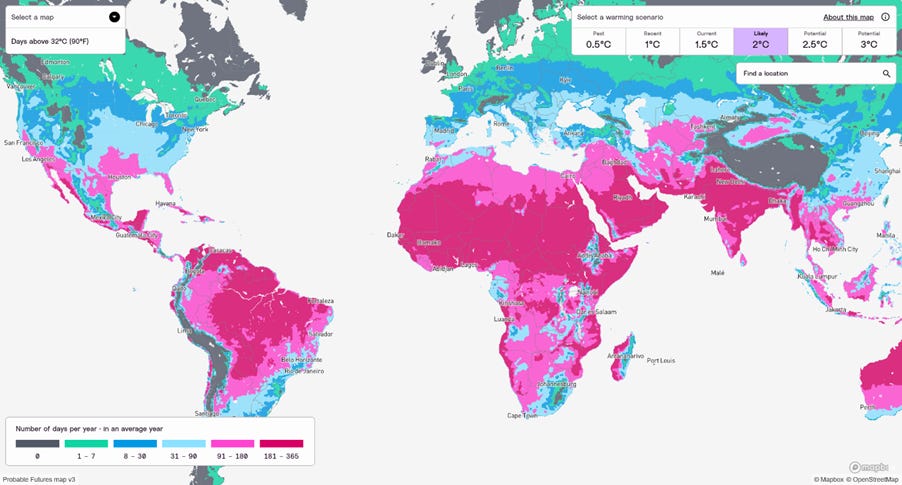
As you can see, the trend we saw at 1.5 degrees of warming has continued, with those parts of the world already experiencing extreme heat days experiencing more of them. And more areas starting to experience extreme heat for the first time.
If we consider what things would be like at 3 degrees Celsius of warming, which is something that falls well within the range of likely climate scenarios for the rest of this century, we can see that extreme heat is something that now impacts on pretty much everywhere across the planet, with the exception of the polar regions and certain extremely high or mountainous areas.
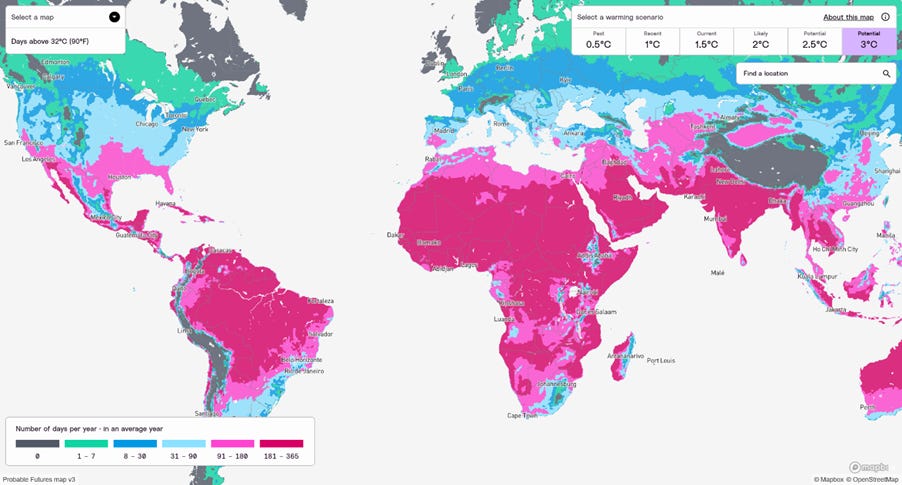
In broad terms, many countries that only infrequently experience extreme heat days will experience them more frequently. Countries that already experience extreme heat days will experience more of them. And some countries that have never experienced extreme heat days are going to experience them for the first time.
For much of the world, then, extreme heat days are going to stop being an extraordinary event, which we manage to just about cope with, to something that we experience on a regular basis.
We’re going to see longer heat seasons and fewer safe daytime working hours.
And we’re going to need to adapt to our changed reality.
We’ve grasped the problem, but not the solution(s)
The conventional advice to those working outdoors in extreme heat is to wear light clothing that covers the skin, to put on a sun hat, to drink lots of water, to try to avoid heavy exertion in the warmer parts of the day and to take lots of rest in shaded areas.
This is fine for the odd warm day. But it’s really not going to work if we’re faced with extended periods of extreme heat for much of the year.
In researching this article, I’ve read quite a few studies of the effects of extreme heat on outdoor workers. And they all come to the same conclusion:
1. Extreme heat is bad for the human body.
2. Undertaking physical labour in temperatures above 30 degrees Celsius (or thereabouts) is a very bad idea.
3. We really shouldn’t do it. And we shouldn’t ask anyone else to do it, either.
It is not, however, overly practical for all outdoor work to simply cease when temperatures go above 30 degrees. Especially not if such temperatures continue for weeks – or even months – at a time.
So what are we supposed to do?
This is where the research starts to get a little vague. Some studies raise the problem and then leave it there. Others talk vaguely about things like protecting vulnerable workers or embracing cooling technologies. But there’s little in the way of concrete solutions.
I don’t think, though, that this means nobody knows the answer.
I think it means that people know the answer, but don’t want to be the one to say it.
Because, quite simply, the increase in extreme heat that we’re likely to experience as a direct impact of climate change is going to mean that, in many parts of the world, we just won’t be able to continue to do things in the way we’ve always done them. And in some cases, we won’t be able to continue to do them at all.
And the impact of this could be huge.
We need to change what we do and how we do it
We’re going to need to make some big changes when it comes to outdoor work.
We’re going to need to redesign working practices, for example, to cope with extreme heat. We’re going to need to restructure the working day – and, quite possibly, the working year – to avoid the hottest parts. To redesign the clothes that workers wear. To install outdoor cooling technologies such as misting and shading.
We’re going to need to engage in real-time temperature monitoring and forecasting. And to adopt a more agile approach to who does what, when and where.
We’re also going to need to employ greater automation and autonomous technologies, so that workers don’t need to work outside at all. After all, if we can do it on Mars, we can do it in Minnesota. And we’re going to have to address inequality, so that poorer and more vulnerable workers don’t feel compelled to put themselves at risk to earn a living.
We may even need to rethink various industries that rely on high levels of outdoor work in areas prone to extreme heat. Because some of them are unlikely to remain viable in the longer term.
And we need to take action now
We’re going to need to do things differently. And, in some cases, we’re going to need to do different things. And it’s going to be hard. Especially in industries that rely on significant amounts of outdoor work, such as agriculture and construction.
Telling people to wear a hat and to drink more water is not going to cut it.
Given how much we struggle with outdoor working in extreme heat now, we’re most definitely not prepared for what is to come.
Wherever we are in the world, we need to take action urgently to adapt to the extreme heat that we’re experiencing, that we’re going to experience more frequently and that we’re going to experience more severely.
Because neither we nor those who work outdoors on our behalf are resilient to extreme heat. And we have only a limited amount of time to do something about it.