

Electricity, energy and why the difference matters
Electricity and energy are not the same thing. And by focusing on the former, we’re failing to address the latter.

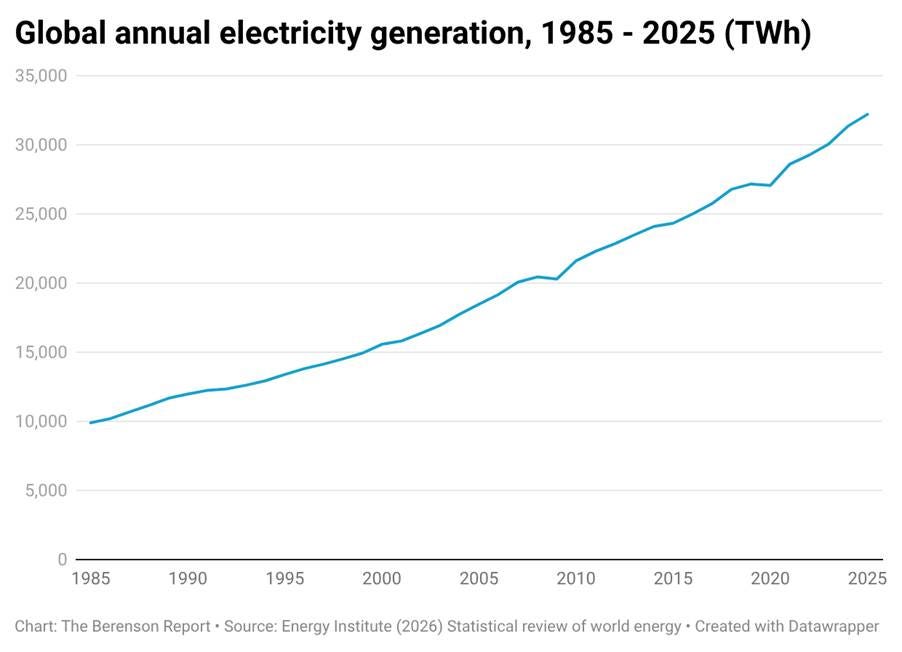
As a planet, we use a vast amount of electricity. Around 32,000 terawatt-hours (TWh) a year, in fact. That’s 32 thousand billion kilowatt-hours, if you prefer. Which, if I’ve got my maths right, is enough to power a single 100 watt incandescent light bulb for three times the age of the universe.
Furthermore, we’re using more and more electricity every year. Back in 1985, we collectively used around 10,000 TWh annually. And, as you can see from the chart below, our consumption has increased rapidly each year, with the exception of tiny dips for the financial crisis in 2008 and the COVID-19 pandemic in 2020.
From a climate change point of view, though, it’s not so much about the amount of electricity we use as how we generate it.
Because if we’re generating electricity by burning fossil fuels, we’re driving greenhouse gas emissions and contributing to the climate crisis. Whereas if we’re generating electricity from wind, solar or other renewable sources, the impact on the climate is significantly reduced.
This isn’t to say, of course, that generating electricity from renewable sources doesn’t have any climate impact at all. Because things like installing wind turbines and manufacturing solar panels still have a carbon cost. But as a way of generating electricity, they’re much more friendly to our climate than burning fossil fuels.
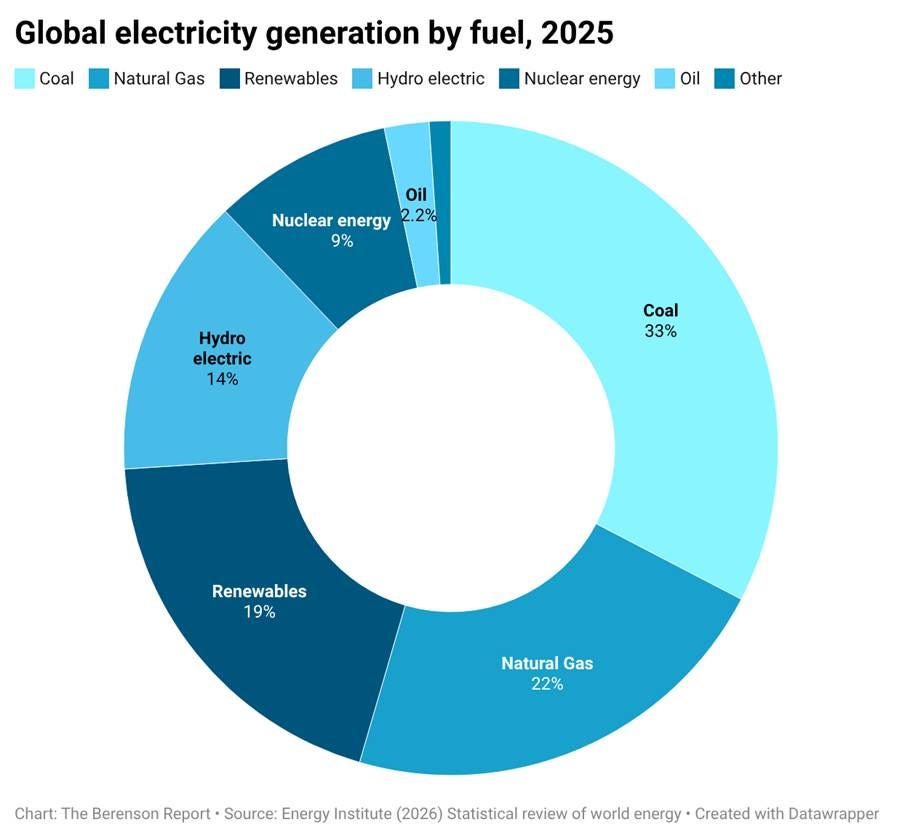
As you can see from the chart above, though, renewable and hydroelectric sources in 2025 together made up 33% – or a third – of global electricity generation.
This rises to 42% if you include nuclear energy. Which I’m reluctant to do, to be honest, as the carbon cost of mining uranium and of building a nuclear power station is far from negligible. And then there’s the issue of radioactive waste. But a lot of people do regard nuclear as a ‘green’ energy source. And I can understand their argument, even if I struggle to accept it.
But decarbonising electricity is only part of the picture
The drive to decarbonise the generation of electricity around the world is a big part of the fight against climate change.
If we can burn fewer fossil fuels to generate the electricity we use to power things like our homes and offices, then we’ll pump fewer greenhouse gases into the atmosphere. And we’ll, hopefully, reduce the rate at which global temperatures rise.
The decarbonisation of electricity generation is, however, only part of the picture. Because electricity generation is only one of the ways we use energy. And it’s not even the main way.
The chart below shows electricity generation and overall energy supply for the period from 1985 to 2025, both in terawatt-hours. It’s not a perfect analysis, but it’ll serve as a useful proxy for thinking about the role of electricity in our overall energy usage.
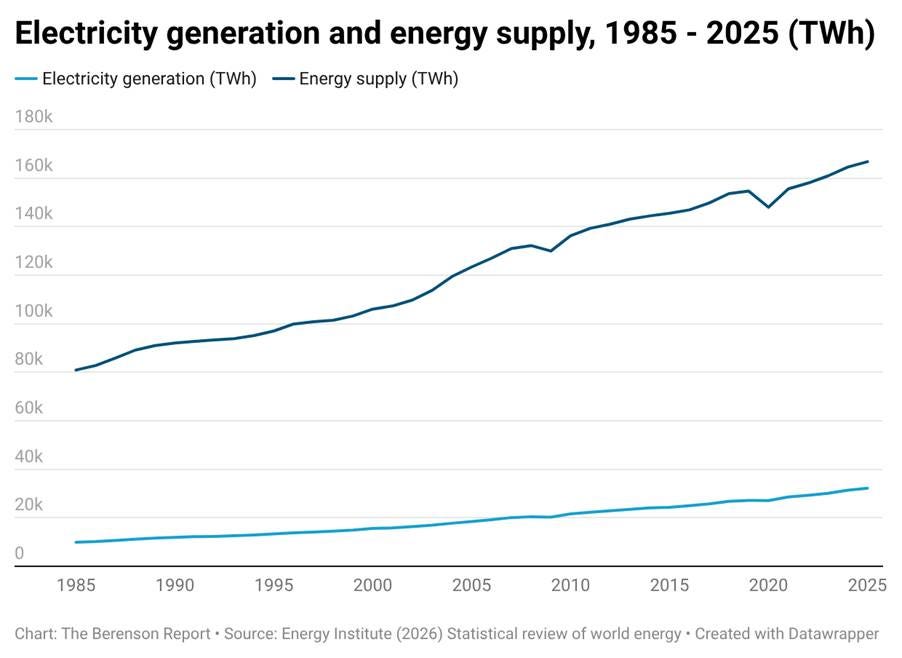
As you can see, like electricity generation, the energy we create each year follows an upward trajectory. With the slight exception, as with the electricity data, of tiny dips in 2008 and 2020. (I’m fascinated by the way world events are reflected in statistics like these, which is why I keep mentioning it. Please excuse me if you couldn’t care less.)
What’s also just about apparent from the chart is that, while electricity makes up a relatively small part of overall energy supply, that part is growing slowly.
This is easier to make out in the chart below, where I’ve pulled out the figures for 1985, 2005 and 2025. You can see here that, in 2025, electricity made up about 19% of our energy usage. And you can see, too, that this proportion represents an increase on the previous years shown.
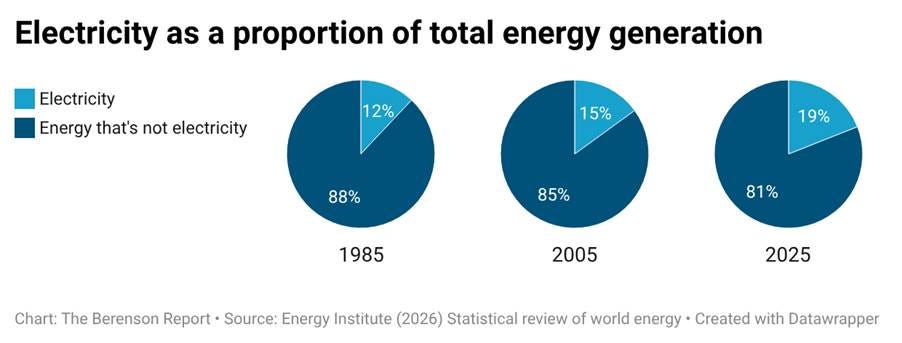
However, we still have a way to go. Because while we’re making progress on generating more of our electricity from climate-friendly sources, this isn’t helping us to make inroads into the more than 80% of energy supply that doesn’t come to us in the form of electricity.
We still rely on burning fossil fuels
This is problematic because, as the chart below shows, the vast proportion of our global energy supply – 86%, in fact – comes from the burning of oil, coal and natural gas. Some of this is used to generate electricity, but most of it is used to power things directly. Homes, cars, ships, heavy industry and such like.
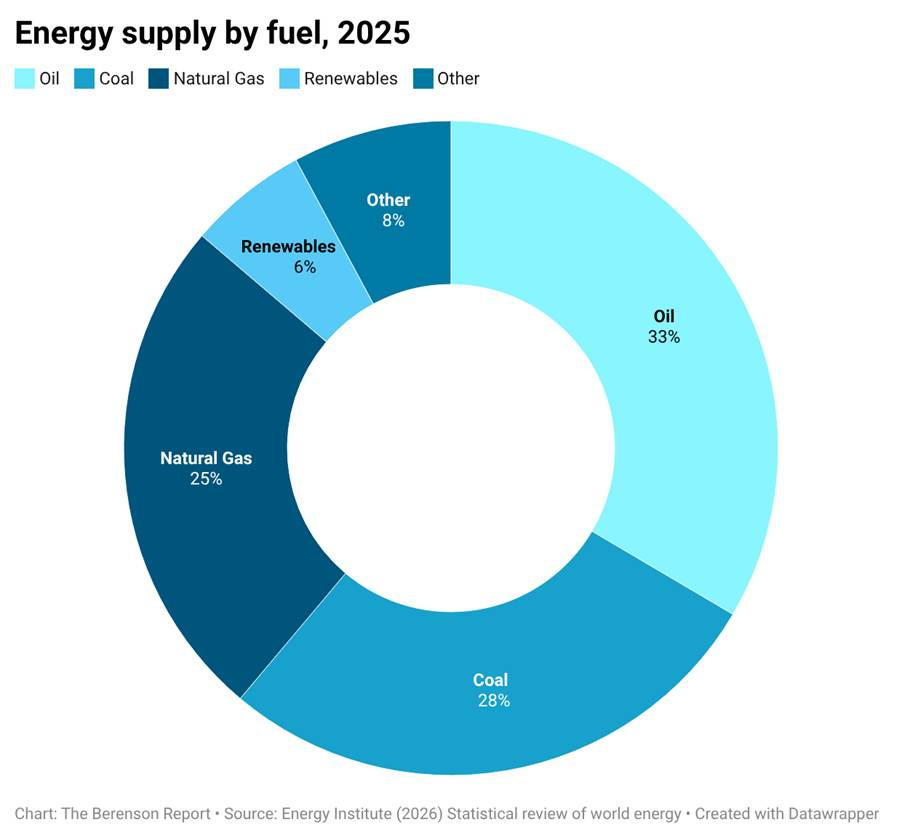
Essentially, then, while a third of global electricity generation comes from renewable sources, around 80% of global energy still comes from the burning of fossil fuels.
And no matter how much effort we put into building wind turbines and installing solar panels, our efforts to generate more of our electricity from renewable sources will do nothing to reduce greenhouse gas emissions from those energy users who burn fossil fuels directly.
Indeed, if we look just at oil, natural gas and coal, as in the chart below, we see that comparatively little of the energy generated from the fossil fuels we burn is used to generate electricity. Indeed, for oil practically none of it is.
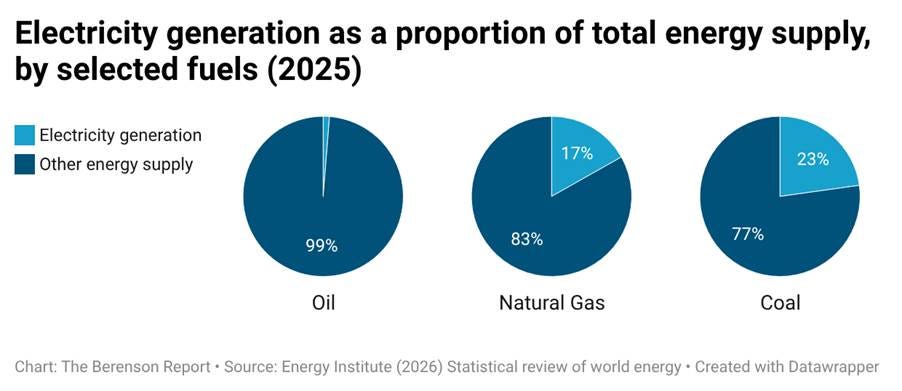
Consequently, there is a growing focus in climate change mitigation circles on greater electrification of our energy generation infrastructure.
It’s essentially a two-step process. First, we electrify things. Then we make them run on renewable energy. Take cars, for example. A petrol-fuelled car can only run on petrol. So however you drive it, you’re burning a fossil fuel and generating greenhouse gas emissions.
If you trade in your petrol car for an electric one, though, you’ve electrified your personal transportation. If you then move to a green tariff with your electricity supplier, or get solar panels, you can charge your car with renewable energy. You’ve now pretty much decarbonised the way you get from A to B.
But if you don’t switch to an electric car, you’re stuck with your fossil fuel. And there’s nothing that you, I or anyone else can do to reduce the climate impact of your daily commute.
Is electrification the way forward?
The chair of the forthcoming United Nations COP31 climate summit, Turkey’s environment minister Murat Kurum, is currently calling for a target of 35% of final energy demand to be met from electricity by 2035.
As we’ve seen already, we’re currently at about 19%, so this represents a significant increase in electrification. So it’s quite an ambitious target. And it’s already meeting a fair amount of resistance. (Electricity pun intended – sorry.)
However, in addition to the environmental argument for electrification, there’s also an economic one. According to Jan Rosenow, Professor of Energy and Climate Policy at Oxford University, electrically-powered technologies are three to five times more efficient than the fossil fuel-driven equivalents.
The Guardian newspaper estimates that this increase in efficiency means we could potentially be looking at a halving of energy demand. Which means, in turn, that electrification could also result in significant cost savings in the long run.
Electrification is, however, easier said than done. Sure, we’re making reasonable progress in getting people – including me – to switch to electric vehicles. But everyone who has a car needs to buy a new one every once in a while, so it’s no great shakes to buy an electric one instead of a petrol- or diesel-powered version.
But if you’re running a blast furnace or a fleet of container ships or a space programme, switching to electricity is a much larger challenge. And in many cases, the technology simply isn’t there.
Furthermore, while fossil fuels spell trouble for the environment, they do have distinct advantages as a source of energy. They’re generally quite easy to store and to transport, for example. You can divide them up easily into the amounts you need. And they also often attract considerable subsidies – especially in times of volatile supply, like at the moment – from governments keen to keep them affordable to consumers.
Electricity, in comparison, and no matter how it’s been generated, is much more challenging to distribute and to store. Distribution requires networks of pylons and transmission wires, for example. And storage necessitates large-scale battery facilities or other mechanisms, such as storage in the form of electrolysed hydrogen held in vast salt caverns.
(Electrolysed hydrogen is hydrogen produced by using electricity to convert water into its constituent hydrogen and oxygen. Hydrogen in its gas form can then be stored, transported and used to generate energy.)
These challenges aside, it’s clear among experts that electrification of the global economy represents the most viable route – and possibly the only realistic route – to a low-carbon world.
Electrification as a path to climate resilience
I’d argue, however, that electrification is also the key to energy resilience in a climate-changed world.
Think about it like this. If you have a petrol-fuelled car, you need petrol to power it. So if there’s a petrol shortage, or if prices rise above what you can afford, you’ve got a problem. But if you’ve got an electric car, you can power it in a multitude of ways. Using electricity from the national grid, for example, or from a local electricity network. Or from solar panels on your roof. Or from a wind turbine.
The same principle applies to gas-powered central heating, diesel-combusting container ships, coal-fired heavy industrial processes and everything else that is designed around the burning of specific fossil fuels.
Electricity is electricity, regardless how it’s been generated. If you can’t get it from one source, you can get it from another. You can even generate it yourself, if you have the space and are able to invest in the right kit.
Consequently, by electrifying the way we power our daily lives, from transport and our homes to industry and the wider economy, we’re essentially protecting ourselves from volatility in energy provision (including price volatility) and making ourselves more resilient to energy shocks.
And in a world where global temperatures could rise between 2 and 4 degrees Celsius – and possibly more – by the end of the century, the scope and scale of such shocks are set to increase.
There’s likely to be increasing political pressure to move away from oil, coal and natural gas, for example. Geopolitical tensions may well impact on the trade of fossil fuels, as we’re seeing right now in the Strait of Hormuz. Climate-related conflict may likewise have adverse impacts on fossil fuel production and transportation. Extreme weather might also make transporting and storing fossil fuels more of a challenge.
But not without its challenges
Large-scale electrification of energy will, however, also present its challenges. For starters, we need to find better ways to store electricity, whether it’s generated using renewable sources or through some other means. After all, a coal-fired power station can run 24/7, but solar panels don’t work at night and wind turbines don’t turn when there’s no wind.
We also need to think about how we transport electricity. Those countries that have a national electrical grid system may find that it works reasonably enough at the moment. But what if it needs to transport five times as much electricity as it does now? Does it have the capacity for that? (Spoiler alert: The answer is almost certainly a resounding no.)
We may find that regional or local grid networks start to make more sense, especially if we have a more diverse range of electricity-generation facilities feeding into them. But we’re also going to need to connect these generating facilities to the electrical grid, whether that grid’s national, regional or local.
In the UK, by way of example, low-carbon generation projects currently face a connection delay of up to fifteen years. Yes, a decade and a half. So it appears we’re far from on top of this, even at our current modest level of electrification.
Electrification will also incur significant up-front costs. Electric cars cost more to buy than petrol-fuelled ones, for example, even if the running costs are lower. And taking out your home’s gas boiler and fitting an air-source heat pump is far from cheap, especially if you need to retrofit insulation and other associated bits and pieces.
But the cost of retrofitting a fleet of aircraft to run on electricity, or a large-scale industrial plant, is going to be astronomical. And that’s if we even know how to go about electrifying them, which in many cases is going to present an additional technological challenge.
Consequently, electrification is going to require significant public investment, funding and subsidy if it’s to be a realistic option.
We need to change, too
The nub of this is that we’ve designed our lives, our homes, our industry and our economies around the easy and consistent availability of cheap fossil fuels.
Moving away from this to greater use of electricity to power our lives – from the way we heat our homes to the way we move goods around the world – is not just a technological challenge. Or even a financial or political one. It’s a psychological challenge.
Because it’s going to mean not just powering things differently, but doing things differently. And possibly even of doing different things.
The journey to a more climate-resilient energy infrastructure is a challenging one. But the first step is comparatively simple. We need to look beyond how we generate our electricity, to how we generate the totality of the energy that we use.
Because electricity and energy are different things. And the difference matters.
Note: In this issue of the newsletter, I’ve made extensive use of the Energy Institute’s Statistical review of world energy, 2026. It’s a hugely informative resource and you can download the report, together with the underlying data, from the Energy Institute’s website. Please note, though, that while the data I’ve used are from the report, the analysis and visualisations are my own. Consequently, any errors in the analysis and interpretation are mine, too.